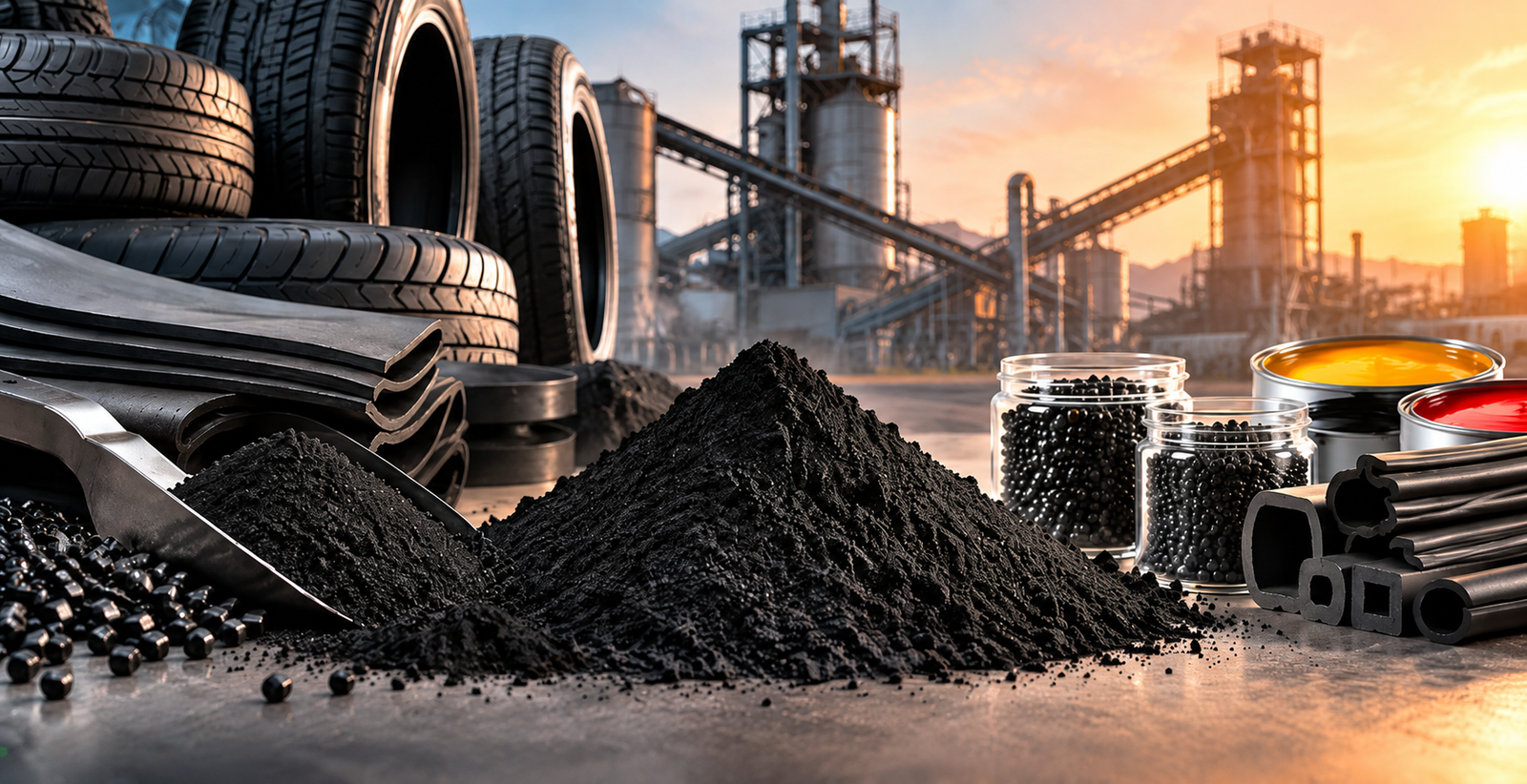
Selecting the right carbon black grade directly affects product performance, durability, processing behavior, color quality, and raw material costs. For manufacturers in Delhi NCR who purchase carbon black in bulk for tyres, rubber products, masterbatch, paints, coatings, and printing inks, the right grade can improve production efficiency and cost control.
Himadri carbon black grades, specifically N220, N330, N550, and N660, each offer a different balance of reinforcement, particle size, structure, and compound processability.
For manufacturers looking for a reliable local supply partner, you can explore Himadri Carbon Black Supplier Delhi NCR for bulk procurement requirements.
What Is Carbon Black and Why Does Grade Selection Matter?
Carbon black is an engineered form of elemental carbon. Manufacturers produce it through controlled thermal decomposition or partial combustion of hydrocarbon feedstock. However, carbon black does more than provide black color. It also works as a high-performance functional additive in many industrial formulations.
Key Performance Benefits in Rubber & Tyres
Carbon black provides several important benefits in rubber and tyre manufacturing:
- Tensile Strength & Hardness: Enhances physical load-bearing capacity.
- Abrasion & Tear Resistance: Increases wear resistance in high-friction environments.
- UV & Weather Resistance: Helps protect products from polymer degradation.
- Electrical Conductivity: Helps control static dissipation or electrical conductivity.
- Processing Characteristics: Changes compound viscosity and flow properties.
Performance in Plastics, Paints, Coatings & Inks
In addition, carbon black provides opacity, deep jetness (black color), UV protection, and rheology control.
Key Rule: Grade selection must align with end-use application, compound performance targets, processing machinery, and overall formulation budget.
At-a-Glance Comparison: Himadri Carbon Black Grades
| Grade | Core Characteristic | Primary Applications | Key Operational Advantage |
|---|---|---|---|
| N220 | High Reinforcement | Tyres, conveyor belts, high-wear rubber items | Superior abrasion & mechanical strength |
| N330 | General-Purpose Balance | Tyres, hoses, automotive parts, moulded goods | Ideal balance of performance & cost |
| N550 | Hardness & Extrusion Balance | Profiles, seals, automotive parts, masterbatch | Smooth extrusion & structural stiffness |
| N660 | Easy Processing | Hoses, seals, cable jacketings, general rubber | Fast mixing, low dynamic heat buildup |
Detailed Breakdown of Himadri Carbon Black Grades
1. Carbon Black N220 – High Reinforcement Grade
N220 has smaller particle sizes. As a result, it provides strong mechanical reinforcement and high wear resistance.
- Typical Applications: Heavy-duty tyre treads, conveyor belts, high-pressure industrial hoses, and mechanical rubber goods.
- Why Choose N220? Select N220 when your compound needs maximum tensile strength and tear resistance.
- Processing Note: Strong reinforcement can increase compound viscosity. Therefore, it can also affect mixing time and machine energy consumption. Evaluate N220 with your complete formulation rather than comparing price alone.
2. Carbon Black N330 – Versatile General-Purpose Grade
N330 is a widely used grade for general rubber compounding. It provides a good balance between reinforcement, wear resistance, processing ease, and price.
- Typical Applications: Passenger car tyres, automotive rubber parts, profiles, seals, industrial hoses, and general moulded goods.
- Why Choose N330? It provides dependable overall performance without the higher processing viscosity associated with N220.
- Price vs. Performance: When comparing N220 and N330 prices in Delhi, consider overall compound throughput and processing ease instead of looking only at the per-kilogram raw material cost.
3. Carbon Black N550 – Hardness & Extrusion Balance
N550 offers a medium particle size with high structure. Therefore, it works well in extruded compounds that need dimensional stability and a smooth surface.
- Typical Applications: Extruded rubber profiles, weatherstripping, automotive hoses, seals, moulded products, and plastic masterbatches.
- Why Choose N550? It provides smooth extrusion, good green strength, and controlled hardness without creating excessive compound viscosity.
4. Carbon Black N660 – Processing-Oriented Grade
N660 has larger particle sizes and moderate structure. Therefore, it focuses more on easy processing, fast compound mixing, lower energy consumption, and high loading capability.
- Typical Applications: Cable jacketings, inner tubes, seals, gaskets, profiles, and low-cost industrial rubber goods.
- Why Choose N660? It provides smooth surface finishes, low heat generation under dynamic stress, and fast processing cycles for high-volume manufacturing.
How to Select the Right Carbon Black Grade for Your Application
Choosing the right carbon black grade depends on the end product, required mechanical performance, processing requirements, and formulation cost. Therefore, Delhi NCR manufacturers should consider these factors before selecting N220, N330, N550, or N660.
For Tyres & Heavy-Duty Rubber Products
Prioritize N220 or N330 when abrasion resistance, tensile strength, toughness, and durability are important. N220 works well for applications that need higher reinforcement. On the other hand, N330 provides a balanced combination of performance, processing ease, and cost efficiency.
For Rubber Profiles & Extruded Products
Choose N550 or N660 based on hardness, dimensional stability, extrusion performance, and processing requirements. N550 provides good structural stiffness and extrusion balance. Meanwhile, N660 works better when easy processing and smooth extrusion are the main priorities.
For Plastics & Masterbatch
For plastics and masterbatch, focus on dispersion, loading levels, melt-flow properties, color performance, and processing conditions. In particular, N550 and N660 can work well when processing efficiency and consistent dispersion are important.
For Paints, Coatings & Printing Inks
For paints, coatings, and printing inks, focus on jetness, opacity, dispersion, viscosity, UV resistance, and color stability. The right grade should match the formulation and required final appearance. Therefore, manufacturers should not select a grade based only on price.
Consider Your Production Process
Before placing a bulk order, manufacturers should test how the selected carbon black performs on their existing production line. In particular, check the following factors:
- Banbury / Internal Mixing Time
- Compound Viscosity & Mooney Scorch
- Extrusion Rate & Surface Finish
- Mould Fill & Vulcanization Behavior
A production trial can help manufacturers confirm the right grade before placing a large-volume order.
Bulk Procurement Guide for Industrial Clusters in Delhi NCR
Delhi NCR has several major manufacturing hubs, including Bawana, Narela, Okhla, Faridabad, and Noida. Therefore, manufacturers should evaluate both technical and commercial factors when sourcing carbon black powder in bulk.
Essential Supplier Evaluation Checklist
- Grade Authenticity: Ensure that the delivered material matches the technical datasheet (TDS), including Iodine Absorption and DBP Absorption values.
- Batch-to-Batch Consistency: Consistent raw material quality helps prevent formulation changes during high-speed production runs.
- Packaging Options: Choose between 25 kg multi-wall paper bags or 500 kg–1000 kg bulk jumbo bags based on your factory handling setup.
- Technical Documentation: Request a Certificate of Analysis (COA) for every delivered batch.
- Supply Capacity & Lead Times: A local Delhi NCR warehouse can reduce transit time and help minimize inventory holding costs.
Understanding Carbon Black Pricing Factors in Delhi
Per-kilogram prices for Carbon Black N220, N330, N550, and N660 depend on several market factors.
1. Feedstock Oil (CBFS) Prices
Global crude oil and raw carbon feedstock prices can affect carbon black production costs. As a result, market price changes can influence supplier quotations.
2. Order Volume
Suppliers may offer different prices based on monthly or quarterly order volumes. Therefore, larger and recurring orders can provide better commercial terms.
3. Packaging Requirements
Standard packaging and palletized jumbo bag configurations can have different costs. Manufacturers should select packaging based on their storage and handling systems.
4. Logistics & Freight
The supplier’s warehouse location can affect freight costs. For example, proximity to manufacturing units in Bawana, Okhla, Noida, or Faridabad can help reduce transportation expenses.
Tip: For predictable raw material costs, negotiate recurring supply agreements with local Delhi NCR wholesalers instead of relying on spot-market purchases.
Frequently Asked Questions
Which carbon black grade is most commonly used for rubber products?
N330 is the most widely used general-purpose grade because it provides a good balance of reinforcement, processing ease, and cost efficiency. However, manufacturers may choose N220, N550, or N660 based on specific mechanical and extrusion requirements.
Is N330 suitable for tyre compounds?
Yes. N330 is extensively used in tyre sidewalls, treads, and carcass compounds. It provides a useful combination of abrasion resistance and flex durability.
What is the primary difference between N220 and N330?
N220 has smaller particle sizes and therefore provides higher reinforcement and abrasion resistance than N330. However, N220 can increase compound viscosity, which can make processing more difficult than N330.
What is N550 carbon black used for?
N550 is mainly used in extruded rubber goods, automotive weatherstrips, hoses, seals, moulded products, and plastic masterbatches. It works well where manufacturers need smooth surfaces and good structural stability.
What is N660 carbon black used for?
N660 is used in inner tubes, cable jacketing, gaskets, seals, and general industrial rubber products. It suits applications that need easy extrusion, low heat buildup, and higher filler loading.
Where can I buy bulk carbon black powder in Delhi NCR?
Bulk supplies can be procured from authorized chemical and carbon black wholesalers serving industrial zones such as Bawana, Narela, Okhla, Faridabad, and Noida.
For manufacturers looking for bulk procurement options, Carbon Black Powder Wholesaler in Delhi can be considered for sourcing carbon black powder for industrial applications.
How should manufacturers compare supplier quotations?
Manufacturers should compare the total landed cost rather than only the initial price per kilogram. Therefore, evaluate technical specification compliance, batch consistency, packaging quality, payment terms, and local delivery reliability before choosing a supplier.
Final Recommendation
There is no single “best” carbon black grade for every application. Instead, select N220 for maximum wear and strength, N330 for balanced all-round performance, N550 for smooth extrusions and hardness, and N660 for fast processing and cost optimization.